


Ready to Upgrade Your Lighting?
Get help choosing the right AEON LED solution for your field, facility, venue, or outdoor space.


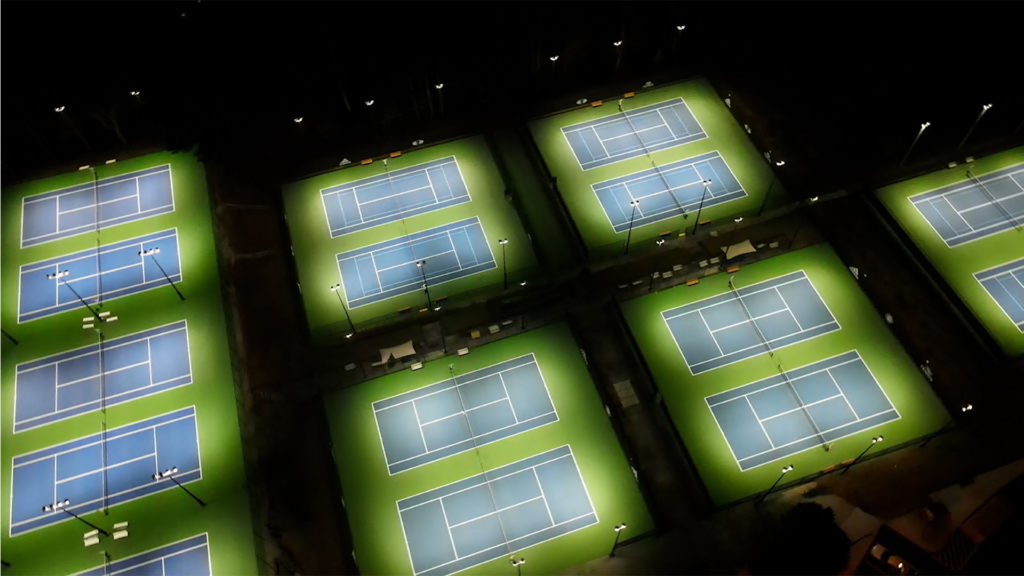
Outdoor tennis court lighting lets clubs, schools, parks, and recreation facilities extend play beyond daylight hours. Whether you are lighting new courts or replacing an existing system, start with the court arrangement, available mounting locations, and intended operating schedule.
AEON offers lighting products and layout support to help you evaluate your outdoor tennis project. Review the proposed fixtures, calculated court illumination, and installation requirements together rather than choosing equipment by wattage alone.
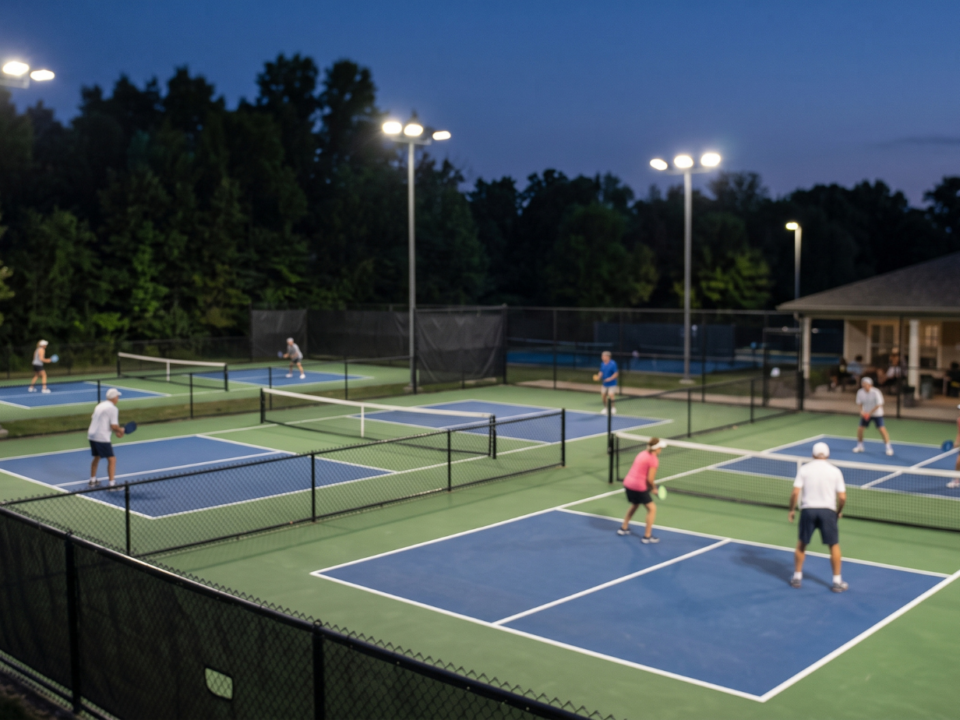
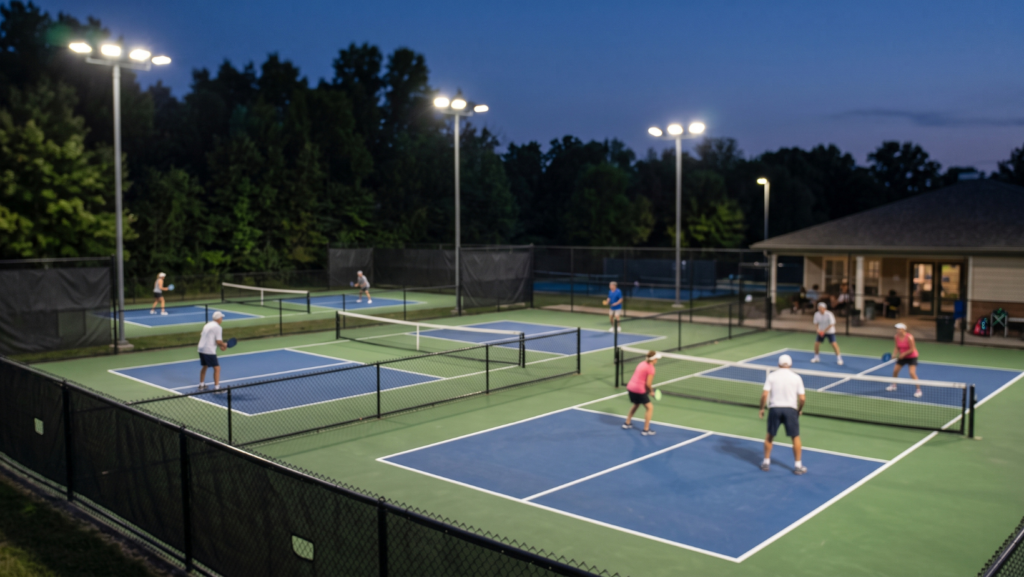
Tennis court lighting must provide consistent visibility across the full playing surface while limiting glare for players looking upward during serves, lobs, and overhead shots. Uneven or harsh lighting can make the ball harder to track and reduce play quality.
AEON LED tennis court lights are designed for schools, clubs, parks, and recreation facilities that need reliable court illumination with reduced energy use and lower maintenance.
A professional tennis court lighting layout helps determine fixture count, mounting height, beam spread, aiming, light levels, and uniformity before installation begins.

Regulation tennis balls, despite their bright green and orange colors, can be challenging to spot on the court if the lighting is suboptimal. Inadequate or uneven lighting, or lighting that contributes to glare, can adversely affect gameplay.
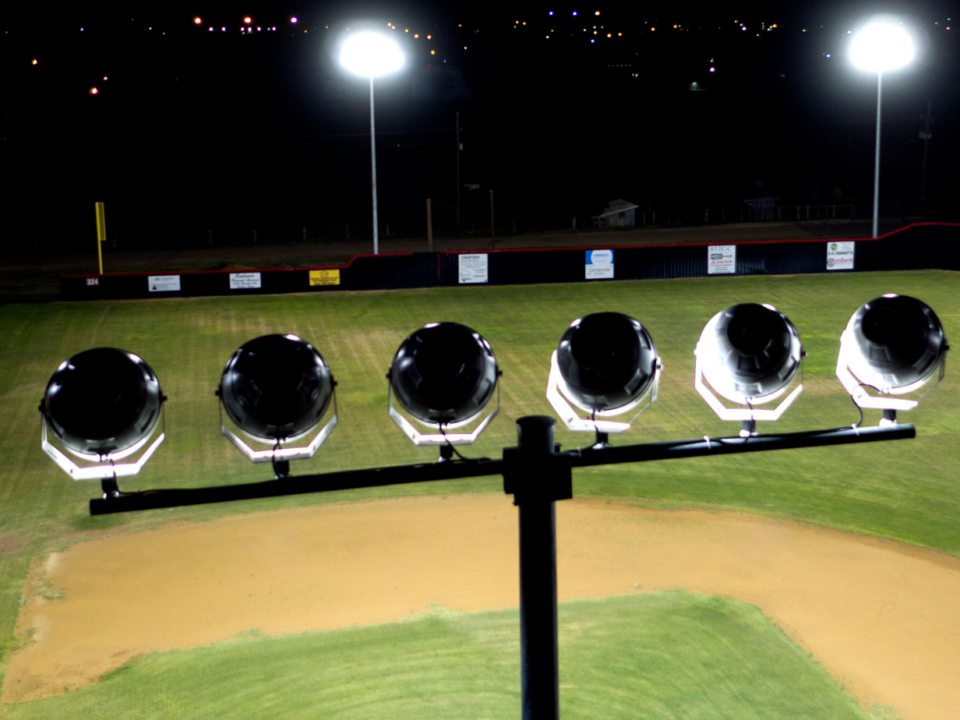
AEON LED luminaires address these issues by reducing glare and letting facility directors choose from a range of beam angles for targeted illumination. They also feature a high color rendering index, making the ball easier to spot and allowing players to deliver their best performance.
High color rendering and targeted illumination help players see the ball more clearly during fast play.
AEON LED luminaires help limit glare for players looking upward during serves, lobs, and overhead shots.
A lighting layout helps determine fixture count, mounting height, beam spread, aiming, light levels, and uniformity.
Identify nearby homes, roads, parking areas, and other locations where unwanted light could be a concern. Share a site plan showing the courts, property boundaries, and proposed or existing poles so the lighting design can account for those relationships.
Ask how fixture placement, optical distribution, and aiming will address illumination on the courts and light outside the playing area. Include any known operating restrictions in the project brief rather than waiting until equipment has been selected.
For a multi-court facility, explain whether all courts operate together or whether individual courts need separate schedules. Confirm the proposed control arrangement before assuming that every court can be switched independently.
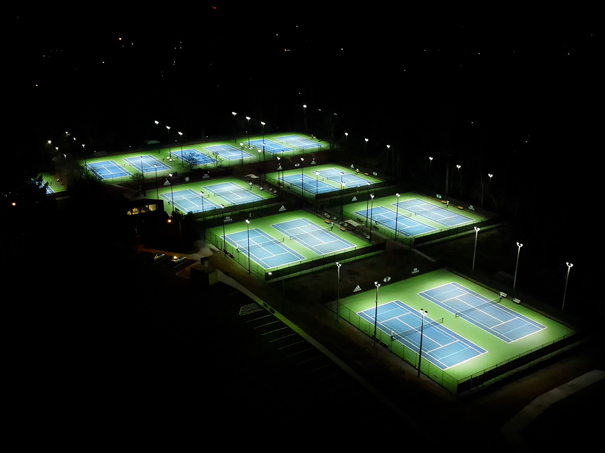
AEON’s Blackburn Park Tennis Center case study documents a lighting upgrade across 18 courts. The project retained 48 existing poles and replaced the previous fixtures with an equal number of AEON luminaires.
| Project comparison | Previous installation | AEON installation |
|---|---|---|
| Fixture count | 108 | 108 |
| Reported connected lighting power | 116,640W, including ballast draw | 24,840W |
The published figures represent approximately 79% lower connected lighting power. Actual electricity savings depend on operating hours and controls. This project’s ability to reuse its poles does not establish that another facility’s poles will be suitable.
Share the number and arrangement of courts, existing pole locations, mounting heights, fixture counts, and available electrical information. Identify whether you are planning a new installation or evaluating a retrofit, and include the intended level of play and operating hours.
For an existing facility, provide available drawings and photographs taken from ground level. Have the appropriate project professionals assess the poles, foundations, mounting hardware, and electrical infrastructure before assuming you can reuse those components.
Compare the proposed AEON equipment and current product documents with your site requirements. Confirm the selected model’s mounting requirements, environmental ratings, electrical configuration, and available controls before ordering.
Tell AEON about your outdoor courts, existing lighting, and project goals. Request a tennis lighting estimate to begin discussing equipment options and the information needed for your facility.
Need a lighting plan first? Request a sports lighting layout.
Planning an enclosed facility instead? Review our indoor tennis lighting information for building-specific considerations.
Have the existing poles, foundations, mounting hardware, and electrical infrastructure evaluated for the proposed equipment. Share available drawings and site information before assuming that your project can be completed as a fixture-only replacement.
Identify that requirement during planning. Ask AEON to confirm the necessary control groups, equipment, and electrical arrangement, particularly where poles or fixtures serve more than one court. Do not assume independent court control is included automatically.
Include surrounding properties and other sensitive areas in the project brief. Ask the lighting designer to evaluate fixture positioning, aiming, available shielding, and the applicable boundary criteria. Establish the intended operating schedule in the same discussion.
Request a layout based on your actual court arrangement, mounting locations, proposed equipment, and intended use. Another facility’s fixture count is a reference point, not a design for your courts.
Get help choosing the right AEON LED solution for your field, facility, venue, or outdoor space.