


Ready to Upgrade Your Lighting?
Get help choosing the right AEON LED solution for your field, facility, venue, or outdoor space.


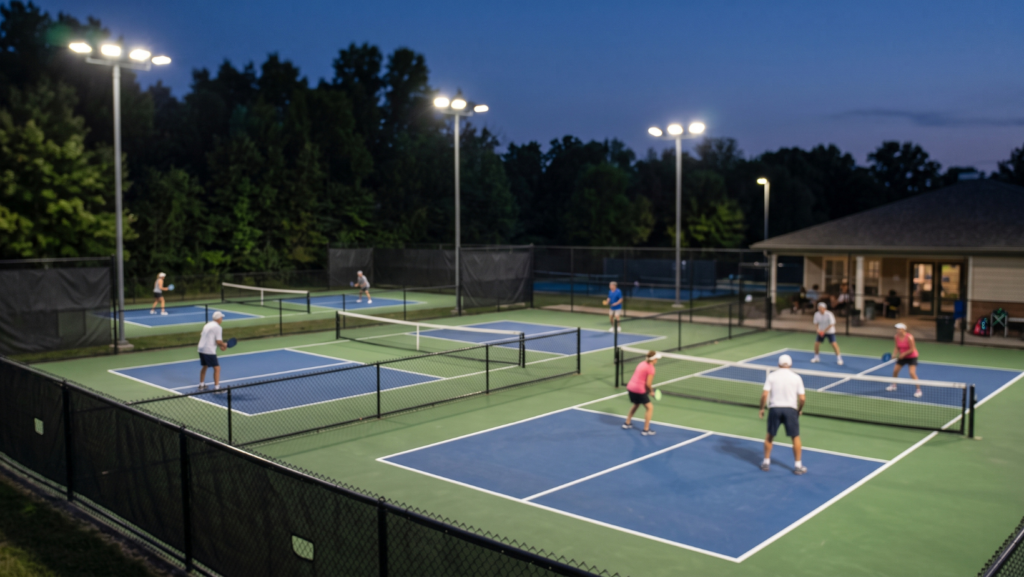
Your tennis courts already have lights. Before budgeting for a pickleball conversion, it is reasonable to ask whether those fixtures can stay or whether the project requires an entirely new lighting system.
You may be able to reuse existing fixtures, poles, or other infrastructure, but those are separate decisions. The proposed court arrangement needs a lighting evaluation, while the poles, mounting hardware, and electrical system need separate assessments. A lighting layout does not establish that an existing pole or foundation is suitable for a new configuration.

Start by defining the project. Will the facility continue hosting tennis, or will the space become dedicated pickleball courts?
Provide drawings showing both sets of playing lines and explain how each sport will use the space. Ask the lighting designer to evaluate both arrangements rather than assuming that a plan suitable for one automatically serves the other.
Provide the proposed pickleball layout, including court boundaries, surrounding playing space, gates, and divider fencing. Do not base the lighting discussion on the old tennis drawing alone.
Before adding permanent lines, confirm their acceptability with the organizers of any sanctioned tennis activities you intend to retain. Some organizations restrict additional court markings.
Make these decisions before selecting fixtures. Your lighting proposal should respond to the intended use of the facility—not force the new courts to work around an unexamined equipment choice.
Treat this as a question to test, not an automatic yes or no.
Consider this when their condition, documented performance, mounting arrangement, and controls remain suitable for the proposed courts. Request an evaluation of the new layout before deciding that no changes are necessary.
Evaluate whether new luminaires could serve the revised playing areas from the existing mounting positions. Confirm the proposed equipment’s lighting performance and compatibility with retained structures and electrical systems.
If the existing locations or infrastructure cannot support an appropriate solution, compare the implications of different mounting positions, additional equipment, or replacement components.
Do not assume that “already LED” means “ready for pickleball.” You still need to evaluate uniform illumination, color quality, and glare control for the proposed courts.
A photometric layout is a computer-based calculation of how selected lighting equipment is expected to illuminate a defined site. It uses information such as fixture locations, mounting heights, optical distributions, and aiming directions. Its results depend on those inputs and assumptions.
For a tennis-to-pickleball conversion, request results for the individual playing areas, not just an average across the entire enclosure. Ask how average and minimum illumination are reported, how uniformity is calculated, and which design criteria apply to the facility’s intended use.
AEON’s guide to reading a sports lighting photometric report explains what to look for when reviewing a proposal.
A sitewide average can conceal uneven illumination or areas with substantially lower readings. Review performance for each playing area.
Consider player positions and viewing directions during serves, volleys, and overhead shots. Explain any existing complaints about glare, shadows, or difficulty following the ball.
Include nearby homes, roads, parking areas, and other sensitive locations in the project brief. Identify operating hours and known site restrictions early.
Request a side-by-side review using the same poles and mounting locations, then identify the fixture or aiming changes being considered. That is more useful than borrowing another facility’s fixture count.

Keeping the poles does not necessarily mean keeping the lights, and replacing the lights does not automatically mean replacing the poles.
Have a qualified structural professional assess the existing poles, foundations, anchors, and mounting assemblies for the proposed equipment. The review should account for condition, fixture and bracket loads, and wind exposure. Wind loading depends on the equipment’s projected area and configuration, not simply its electrical wattage or weight.
Have a qualified electrical professional evaluate the existing electrical installation separately, including compatibility with the proposed fixtures and controls. Provide available drawings, equipment records, and ground-level photographs.
AEON’s Blackburn Park Tennis Center case study documents an upgrade that retained 48 existing poles while replacing the lighting equipment. That is an example of preserving infrastructure during a tennis lighting upgrade—not a documented tennis-to-pickleball conversion.
Identify this requirement before finalizing the lighting layout and electrical configuration. Ask which fixtures serve each court, which control groups are proposed, and what additional equipment or electrical work is needed.
For a facility with court-by-court reservations, request evaluation of the intended operating combinations. For example, ask whether one booked court will still receive the required illumination when neighboring courts are switched off.
Separate reservations should not be treated as proof that the existing lighting can be controlled separately. Confirm how the proposed system will operate before promising that functionality to members or scheduling staff.
Build the estimate around the work required at your site rather than a generic price per court. Ask for a proposal that separates the major components.
| Cost Component | What to Clarify |
|---|---|
| Lighting equipment | Proposed models, fixture quantities, optical configurations, and accessories. |
| Mounting changes | Required brackets, adapters, mounting adjustments, or replacement hardware. |
| Poles and foundations | Which components can remain and what work is needed where they cannot. |
| Electrical work | Wiring, circuit changes, control connections, and other installation requirements. |
| Installation access | Lift access, working space, court protection, and restoration responsibilities. |
| Controls | Switching groups, scheduling, commissioning, and optional remote-access features. |
| Design and verification | Included calculations, engineering responsibilities, installation checks, and exclusions. |
Compare proposals against the same project scope. A fixture-only quote and a complete installed-system quote should not be treated as equivalent.
Evaluate operating costs separately from the purchase price. Estimate electricity use from the proposed system power and actual operating schedule, then apply the applicable utility rates. If the conversion extends evening hours, lower power consumption does not necessarily produce the same percentage reduction in the electricity bill.
Prepare the information you have available and identify anything that still needs to be confirmed. Use this checklist to organize the initial discussion.
| Project Information | Helpful Details |
|---|---|
| Facility location | Address and a site plan showing the court enclosure and surroundings. |
| Existing court arrangement | Current tennis layout, court dimensions, fencing, gates, and access points. |
| Proposed conversion | Shared-use or permanent conversion, proposed pickleball court arrangement, and surrounding playing space. |
| Existing lighting | Fixture manufacturer and model, quantity, current wattage, and photographs. |
| Mounting information | Pole locations, mounting heights, available drawings, and equipment records. |
| Electrical and controls | Known voltage, current switching arrangement, and desired court-by-court operation. |
| Intended use and timing | Recreational or competitive use, operating hours, project stage, and target opening date. |
Include the problems you are trying to solve, not just the equipment you hope to keep. Uneven coverage, unwanted light, maintenance access, and inconvenient switching are all worth raising during the project discussion.
Start with the proposed courts, then determine which parts of the lighting system can support them. Tell AEON about your existing courts, planned conversion, and project goals so you can begin evaluating lighting options for the new arrangement.
Possibly, but we should evaluate the proposed pickleball layout before deciding. Existing fixture condition, mounting positions, optics, controls, and modeled performance all matter.
They may be reusable, but that is a structural and project-specific decision. Qualified professionals should evaluate existing poles, foundations, anchors, mounting assemblies, loads, and wind exposure.
No. The technology type alone does not confirm that the system provides the right court coverage, uniformity, glare control, color quality, or aiming for the proposed pickleball arrangement.
Potentially. Confirm that requirement before finalizing the lighting layout and electrical configuration. Confirm the proposed control groups, equipment, wiring, and operating combinations rather than assuming independent court control is included automatically.
Provide the facility location, existing tennis layout, proposed pickleball arrangement, current fixture information, pole locations and heights, available electrical information, operating schedule, level of play, and any available photographs or drawings.
Cost depends on the equipment, mounting changes, pole or foundation work, electrical changes, installation access, controls, design work, and site verification required. Compare proposals against the same project scope instead of relying on a generic price per court.
Get help choosing the right AEON LED solution for your field, facility, venue, or outdoor space.