


Ready to Upgrade Your Lighting?
Get help choosing the right AEON LED solution for your field, facility, venue, or outdoor space.


Athletics continue to be an important part of schools, communities, universities, recreation programs, and professional venues. The technology used to light sports arenas, gymnasiums, and outdoor fields is also becoming more important as facilities support athletes, spectators, staff, and, in some cases, recorded or streamed events.
Modern lighting technology continues to change, giving facility owners more choices in efficiency, optical control, lighting controls and system configuration. AEON LED sports lighting includes several product families and configurations designed for different sports and facility requirements.
Choosing a sports lighting company is easier when every supplier is working from the same description of your facility. The sport, level of play, field dimensions, existing poles, mounting conditions, and operating schedule can all affect the equipment and planning involved.
Start with the facility address, a site plan or field dimensions, and the sports or activities the lighting must support. For an existing system, include available pole heights and locations, fixture quantities, current wattages, voltage, and photographs.
Explain what is prompting the project. You may be replacing failed equipment, improving visibility, reducing operating costs, adding controls, or planning lighting for a new facility. Include any known lighting criteria, nearby homes or roads, scheduling restrictions, and recording requirements.
If information is missing, ask which assumptions the supplier used and what still needs to be confirmed before the proposed system is finalized.
One area AEON has focused on is thermal management. Heat is an important consideration in LED luminaire design because excessive operating temperatures can affect drivers, LEDs, and other electronic components over time.
AEON luminaires use a proprietary thermal-management approach that includes passive cooling and cross-ventilation. The design is intended to move heat away from electronic and lighting components and support reliable operation in demanding applications, including facilities located in warm climates.

Sports lighting can be exposed to demanding conditions. Indoor fixtures may be installed above active courts or playing areas, while outdoor luminaires must operate through changing weather and environmental conditions.
AEON LED luminaires are designed with rugged housings that protect internal electronics and lighting components. Depending on the selected product and configuration, the luminaire may also include environmental protection suitable for outdoor sports applications.
When comparing a sports lighting company, review the current product documents for the exact luminaire being proposed rather than relying only on general family-level descriptions.
Two sports-lighting proposals can have very different prices because they include different work. Ask each supplier to identify whether its proposal includes fixtures, mounting hardware, controls, poles, electrical work, installation, aiming, and final verification.
Make sure exclusions are written down. Responsibility for reviewing existing structures, electrical capacity and mounting arrangements should also be clear. Lower fixture power or fixture weight alone does not establish whether existing infrastructure can be reused.
Our sports field lighting RFP checklist provides a more detailed list of project-scope, product, controls, warranty, and acceptance items to compare.
In sports lighting, visibility is one of the most important considerations. Athletes, officials, and spectators need consistent illumination across the areas they use, while the lighting design should also consider glare, shadows, and large differences between bright and dark areas.
Current AEON sports-lighting products include configurations with color rendering above CRI 85 and multiple optical distributions. These options allow the proposed equipment to be selected based on mounting locations, field geometry, and the intended application.
Facilities that plan to televise, stream or record events should identify those requirements before the lighting design is finalized. Color rendering is one consideration, but camera locations, frame rates, slow-motion requirements, lighting levels and uniformity may also affect the proposed system.
Outdoor projects should also consider light reaching neighboring properties, roads, and other sensitive areas. Fixture optics, mounting positions, and aiming should be evaluated as part of the actual site layout rather than assuming that one luminaire automatically eliminates spill light.
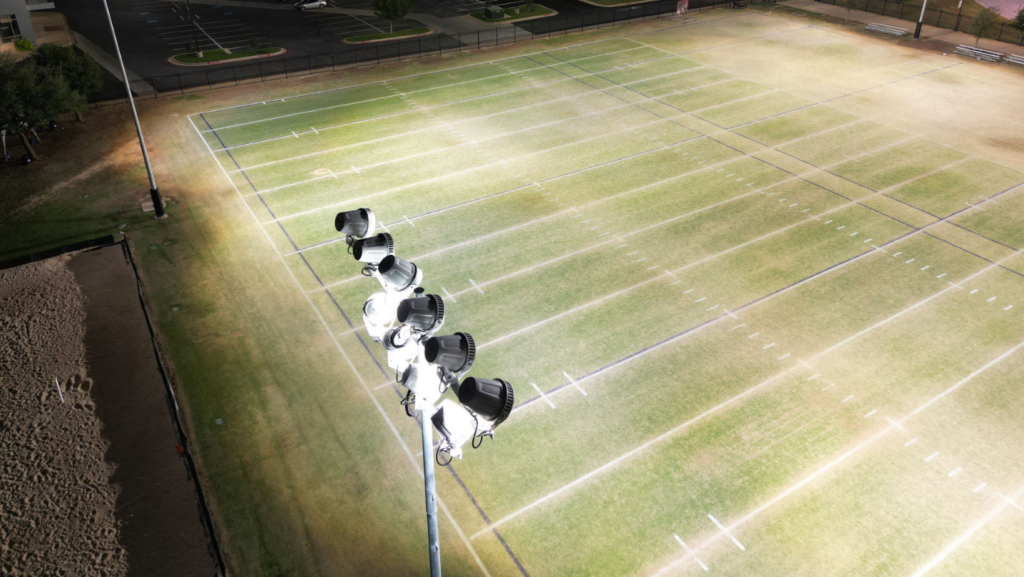
Ask for the model, voltage, optics, mounting method, and controls included in the proposed system. Compare the lighting layout with the actual field dimensions and pole positions. The proposal should explain the lighting criteria being used and identify the equipment behind the calculations.
You can review AEON sports-lighting products and product specifications and installation documents during that process. Confirm that the documents and photometric files match the exact equipment being quoted.
A photometric layout helps evaluate fixture locations, aiming, and calculated performance, but it does not replace the structural, electrical, or installation reviews required for the project.
Sports facility managers need lighting that performs well while remaining practical to operate and maintain. AEON sports luminaires are available with different mounting and optical configurations so the project team can select equipment for the facility rather than trying to make one fixture arrangement fit every field or arena.
Depending on the selected product, available features may include different beam distributions, adjustable mounting and aiming options, remote-driver configurations, and integration with lighting controls. Confirm these features for the actual model being quoted.
Maintenance should also be part of the comparison. Ask about documented product life, warranty terms, replacement components, service access, and the work required if a driver, control component, or luminaire eventually needs attention. A long rated LED life should not be treated as a promise that the complete system will never require maintenance.
Project examples can help you understand how a sports lighting company has approached different facilities. Look for useful details such as the original equipment, replacement equipment, pole arrangement, fixture quantity, controls, and scope of work.
For example, AEON’s Blackburn Park tennis project documents a project that retained the facility’s existing poles while replacing its lighting equipment.
The Slaton baseball field project used a different number of LED fixtures than the previous HID installation while reducing the published connected lighting power.
These examples provide useful questions to ask about your own project. They do not establish the fixture count, pole suitability, energy savings, or lighting performance another facility will achieve.

AEON continues to develop lighting products for indoor arenas, outdoor fields, gymnasiums, stadiums, and other sports applications. The appropriate product and configuration depend on the facility, mounting conditions, required performance, and project goals.
Send us the facility address, the sport or application, and the information you have about the existing lighting. Tell us what you want to improve and your expected schedule.
You can request a lighting layout to begin a discussion based on your facility.
Get help choosing the right AEON LED solution for your field, facility, venue, or outdoor space.