


Ready to Upgrade Your Lighting?
Get help choosing the right AEON LED solution for your field, facility, venue, or outdoor space.


The first question in a stadium retrofit is often, “What LED wattage replaces our 1000W metal halide lights?” The existing wattage is useful information, but it does not determine the replacement on its own.
Two fields using the same lamp wattage can need different LED configurations because their dimensions, pole positions, mounting heights, and lighting requirements differ.
Select the replacement from a site-specific lighting layout that considers the field, pole locations, mounting heights, optics, fixture quantities, and required lighting performance.
Watts describe electrical power. Lumens describe light output. Neither figure alone tells you the illumination at a particular point on the field.
A photometric layout evaluates the proposed fixtures, optics, quantities, and aiming together. Use that calculation to compare the expected light levels and uniformity with the project requirements.
Mounting height and optical distribution matter as much as headline lumen output. Two luminaires with similar wattage or lumen ratings can produce different results when their beam patterns, positions, and aiming are different.
AEON currently publishes three sports-lighting families with several wattage and delivered-lumen options. These products should be evaluated within a lighting design, not as a one-for-one metal-halide replacement chart.
| Sports Series | Published Wattage | Published Delivered Lumens |
|---|---|---|
| ECO SportsView ECO → | 310W 500W |
51,150 lm 80,000 lm |
| PNR SportsView PNR → | 500W 750W |
91,300 lm 113,880 lm |
| PRO SportsView PRO Sports → | 750W 1200W |
126,500 lm 185,700 lm |
Product specifications can change. Confirm the exact model, optics, voltage, accessories, and current document revision before using product information for bidding, ordering, or project submittals.
AEON’s published product information includes HID-equivalent references for individual models, but those figures should not replace a project-specific lighting calculation.
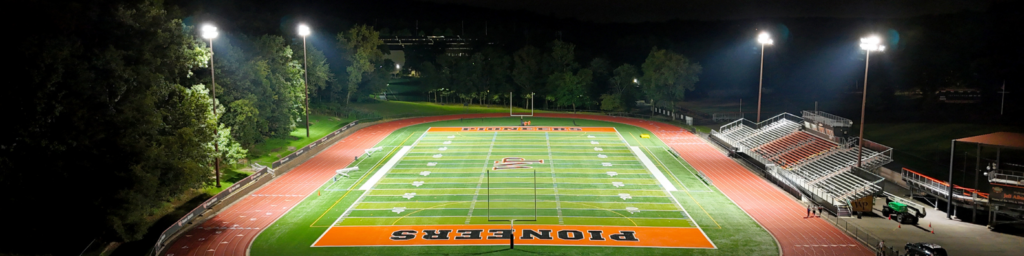
A field with four poles, a field with eight poles, and a stadium with tall high-mast positions can all require different fixture quantities, optical distributions, and aiming even when the existing fixtures use the same metal halide lamp wattage.
For the existing system, account for lamp and ballast input power where applicable. A fixture using a 1000W metal halide lamp may draw more than 1000 watts at the system level because the ballast also consumes power.
Use actual ballast or fixture input information when available, rather than estimating from the lamp rating alone. For the proposed LED system, use the specified fixture input power and proposed fixture quantity.
Annual electricity use also depends on operating hours and controls. A reduction in connected lighting power should not be presented as an identical reduction in the facility’s total electricity bill.
A lower-wattage LED fixture does not automatically establish that existing poles, cross-arms, wiring, or switching equipment can remain.
Fixture weight, effective projected area, mounting configuration, wind conditions, and the condition of the pole and foundation all matter when existing structures are being considered for reuse.
Have the appropriate qualified professionals evaluate structural and electrical suitability before committing to reuse. For more detail, review AEON’s sports lighting pole planning guide.
Gather as much of the existing facility information as practical before requesting a replacement layout.
The goal is not to find an LED fixture whose wattage looks like the mathematical replacement for a 1000W metal halide lamp. The goal is to identify a fixture configuration that provides the required field performance using the actual facility conditions.
AEON’s lighting-layout request asks for the existing wattage, facility type, sport, voltage, pole count, mounting heights and fixture quantities so the replacement can be evaluated around the project rather than a generic wattage conversion.
There is no universal replacement wattage. The appropriate LED model and fixture quantity depend on field dimensions, mounting height, pole positions, optics, aiming, and the required lighting levels and uniformity.
No. Delivered lumens are useful product information, but field results also depend on optical distribution, fixture placement, mounting height, aiming, and quantity. A photometric calculation is the better tool for comparing proposed field performance.
Not necessarily. The lamp rating describes the lamp, while a ballast also consumes power. Use actual fixture or ballast input information when available when calculating the existing system’s connected load.
They may be reusable, but that decision requires review of the existing structure and the proposed fixture arrangement. Pole condition, foundation condition, fixture weight, effective projected area, mounting configuration and site wind conditions can all affect structural suitability.
Get help choosing the right AEON LED solution for your field, facility, venue, or outdoor space.