
Ready to Upgrade Your Lighting?
Get help choosing the right AEON LED solution for your field, facility, venue, or outdoor space.


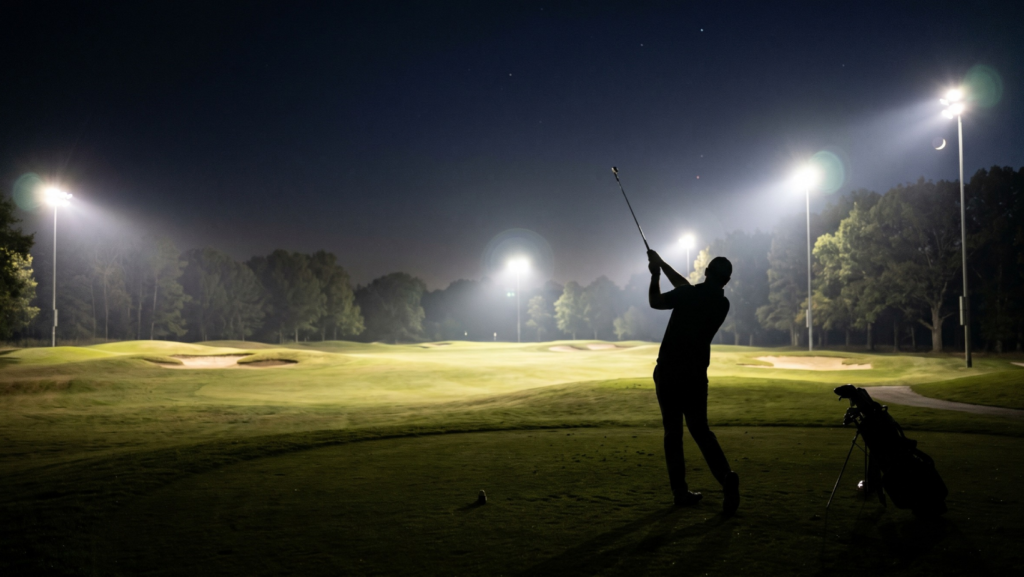
Before selecting lights for night golf, decide what will remain open after sunset. Lighting a driving range, a short-game area, and a complete course are different projects with different operating requirements.
A useful plan starts with the areas being opened, how golfers and staff will use them, and what the lighting system needs to accomplish during those operating hours.
Mark the areas that need illumination and explain how golfers and staff will move between them. Include the hours of operation, staffing arrangements, and any planned future expansion.
A facility may choose to begin with a driving range, putting area, or selected practice facilities rather than illuminate an entire course at once.
A phased project should still provide a complete, usable arrangement for the areas opened in that phase. Future expansion should be considered during planning without assuming that equipment selected for the first phase automatically fits every later area.
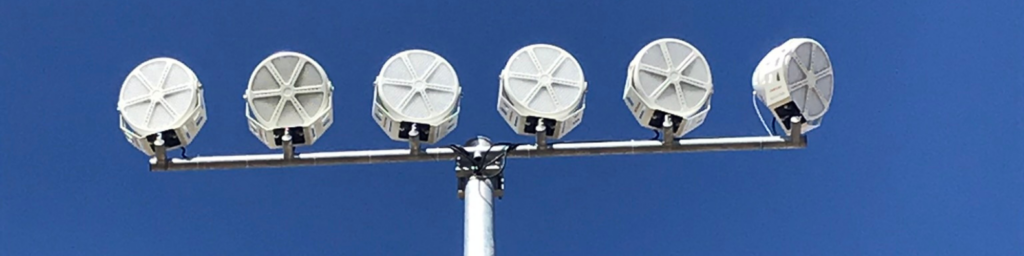 Night golf projects should be planned around the specific areas being operated after dark and the viewing tasks within those areas.
Identify where golfers stand, the direction of play, target areas, and surrounding properties. Include trees, changes in elevation, and other obstructions in the information provided for the lighting review.
On a driving range, the golfer is trying to follow a ball moving away from the hitting position. On a putting or short-game area, viewing distances and tasks differ. Those differences should be reflected in the lighting design.
Ask how the proposed design addresses ball visibility, bright and dark areas, glare, and light reaching beyond the intended area.
One average light level does not describe the entire nighttime experience.
Review what golfers, staff, and spectators need to see from the positions where they will actually be standing.
Examine the proposed fixture positions, optical distributions, aiming, and how the design handles terrain changes.
Identify nearby roads, homes and other areas where unwanted light or direct view of luminaires could be a concern.
If events, video recording, or other specialized uses are planned, identify those performance requirements before equipment is selected.
Determine which areas need separate switching, scheduled shutoff or other control functions. The required controls should be specified with the luminaires and supporting equipment.
AEON’s HyLink controls can support functions such as individual or grouped control, on/off operation, dimming, zones, events and schedules depending on the selected control architecture and luminaire configuration.
Remote access may also be available as part of an appropriate system configuration. These control functions manage how compatible luminaires operate; they should not be confused with physically changing a fixture’s optical distribution or beam angle.
The more accurately the site is described, the more useful the initial lighting review can be.
AEON’s general lighting-layout form also requests information such as facility type, current fixture wattage, voltage, pole count, mounting height and fixtures per pole for applicable projects.
Once the nighttime operating areas and project requirements are defined, the next step is to compare the required optical distribution, mounting arrangement, electrical supply, controls, and environmental conditions with the selected product documentation.
AEON’s golf-course and driving-range lighting information explains those product-selection and site-review questions in more detail.

Not necessarily. A project can be organized around the areas the facility intends to operate after dark, such as a driving range, practice area or selected portions of a course. Each phase should still be planned as a complete usable area.
One number should not be applied to every golf facility or every area of a course. The project should establish the applicable criteria for each area based on its use, viewing task, and any owner or governing requirements.
No. Lighting controls can manage compatible luminaires through functions such as switching, dimming, grouping, and schedules. Optical distribution is a fixture and optic selection decision and should be established as part of the lighting design.
Yes. Identify surrounding properties, roads, and other sensitive locations so fixture placement, aiming, and project-specific off-site-light requirements can be evaluated.
Start with the areas being considered, available drawings, mounting information, and operating requirements. AEON can use that information to discuss the next steps for a project-specific lighting review.
Get help choosing the right AEON LED solution for your field, facility, venue, or outdoor space.