


Ready to Upgrade Your Lighting?
Get help choosing the right AEON LED solution for your field, facility, venue, or outdoor space.


Lighting a driving range is a different task from lighting a putting green. Players need to see different parts of the activity, over different distances and against different backgrounds.
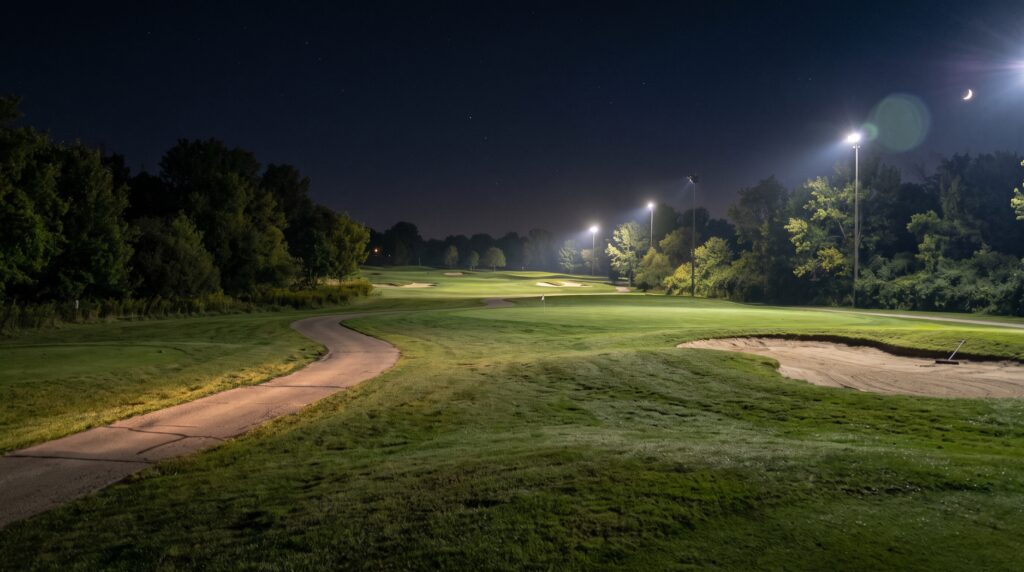
AEON offers LED luminaires for golf-course and driving-range applications. Product selection begins with the areas to be illuminated and how the facility will operate after dark.
A golf facility may include several different lighting tasks. Treat them separately before selecting fixtures or mounting locations.
Consider the hitting positions, direction of play, range depth, target areas, and the player’s viewing direction as the ball travels away from the tee.
Putting greens, short-game areas and practice tees may have different viewing distances, mounting limitations and operational requirements.
Tees, approaches, greens, hazards and circulation areas included in nighttime operation should be identified before the lighting layout is developed.
Describe the hitting positions, direction of play, target areas, range depth, and available mounting locations. The lighting review should consider ball visibility along the intended viewing directions, not just ground illumination.
Also identify structures, netting, terrain changes, and other site conditions that may affect mounting positions or aiming. The objective is to evaluate the actual range rather than apply one fixture arrangement to every facility.
Identify the tees, greens, approaches, hazards, and routes between areas that are included in the project. Terrain, trees and surrounding properties can influence fixture placement and aiming.
A single brightness recommendation cannot describe every part of a golf facility. Establish the design criteria for each area and review the proposed results accordingly.
A useful lighting layout should identify the proposed fixture models, optics, quantities, mounting positions, and aiming assumptions. It should also show the lighting criteria being evaluated for the project.
Depending on the application, the review may need to consider horizontal illumination, vertical illumination, uniformity, or other project-specific criteria. Ball visibility on a driving range cannot be evaluated from a single average ground-light reading alone.
If the fixture model, optic, mounting location, or quantity changes during the project, confirm whether the calculation should also be revised.
Compare the required distribution, mounting arrangement, electrical supply and environmental conditions with the selected product documents. Establish the desired operating schedule and control functions before equipment is ordered.
AEON currently offers multiple sports and flood-lighting product families with different wattages, outputs and optical options. The appropriate product should be selected from the project layout and current documentation rather than a generic golf-lighting wattage recommendation.
For color characteristics, recording requirements, or other specific performance needs, identify what the project requires rather than relying on a general “broadcast-ready” description.
Decide which areas need to operate together and which should be controlled separately. A driving range may not need the same operating schedule as practice greens, walkways, or other areas of the property.
If scheduling, dimming, remote operation, or other control functions are required, identify them during design and confirm the required control interface and components for the selected equipment.
Golf facilities often cover large areas and may be bordered by homes, roads, businesses or other properties. Identify these conditions when preparing the lighting layout.
Review fixture placement and aiming in relation to the areas that need illumination and the locations where unwanted light would be a concern. Site-specific requirements or local restrictions should be identified before the final equipment package is approved.
You do not need every detail finalized, but the following information provides a useful starting point.
Before equipment is selected, define which portions of the facility need nighttime operation, the hours they will be used and what golfers need to see in each area.
Our night-golf planning article provides additional background on nighttime golf applications.
There is no single value that describes every driving range. The appropriate criteria depend on the range geometry, viewing distances, operating goals, and any requirements that apply to the project. Review the criteria within a site-specific lighting layout.
Not by itself. Players need to follow a ball through space and toward distant targets. The lighting review should consider the viewing task and relevant project criteria rather than relying only on an average horizontal reading.
They involve different viewing distances and tasks, so they should be evaluated separately. Fixture placement, optics, and mounting arrangements should be selected around the area being illuminated.
Yes. If the facility needs separate zones, schedules, dimming, or remote operation, identify those requirements so the selected control interface and system components match the intended operation.
Share the facility areas you want to illuminate, available drawings, mounting information, and operating requirements. AEON can help review product options and the lighting approach for the project.
Get help choosing the right AEON LED solution for your field, facility, venue, or outdoor space.