


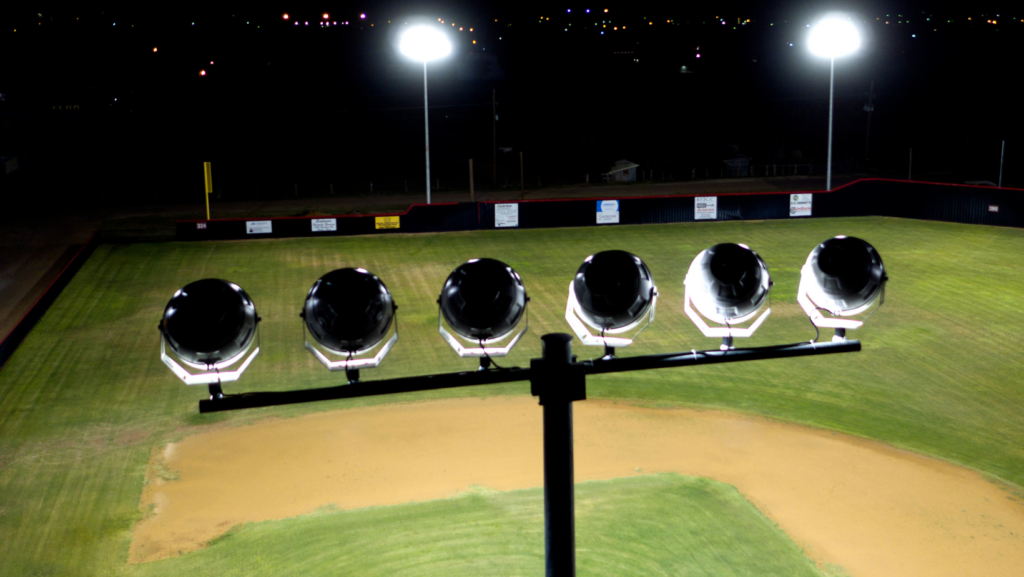
Ready to Upgrade Your Lighting?
Get help choosing the right AEON LED solution for your field, facility, venue, or outdoor space.


A league board needs to know more than the price of new fixtures. It needs to understand what the proposed system will deliver, what work is included, and how the finished installation will be evaluated.
Start with the actual field dimensions, divisions used, existing lighting, and the requirements that apply to the project.
For affiliated facilities, review Little League’s lighting standards and safety audit.
Its published standard-competition reference lists average constant or target horizontal illumination of 50 foot-candles for the infield and 30 for the outfield. It also specifies maximum-to-minimum uniformity ratios of 2:1 and 2.5:1, respectively.
| Area | Average Constant / Target | Maximum-to-Minimum | Maximum Rate of Change |
|---|---|---|---|
| Infield | 50 fc | 2:1 | 10% per 10 ft |
| Outfield | 30 fc | 2.5:1 | 10% per 10 ft |
These figures are only part of the requirements. The complete document also addresses layout, glare, measurement, and other provisions. Confirm the applicable requirements before equipment is selected.
An average can hide differences between bright and dark areas. Ask to see the calculation grid, minimum readings, and uniformity results for the infield and outfield separately.
A maximum-to-minimum ratio divides the highest reading by the lowest. It does not, by itself, establish that an installation has no glare.
Also ask whether the proposal is showing initial values, maintained or target values, and what assumptions are being used. Those details matter when comparing two photometric reports.
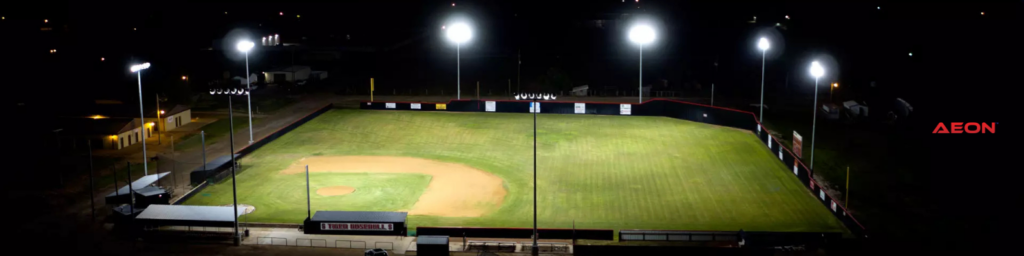
For an upgrade, establish whether existing poles, foundations, mounting hardware, and electrical equipment can remain. For new construction, identify the additional infrastructure and work required.
Ask each supplier to separate equipment, installation, controls, and exclusions so the board can compare similar scopes.
A lower fixture wattage or lower fixture price does not establish the total project cost. Pole work, electrical modifications, access equipment, controls, aiming, testing, and site restoration may affect the final scope.
A useful proposal should make it possible to connect the lighting calculation to the equipment being purchased. Ask the project team to identify:
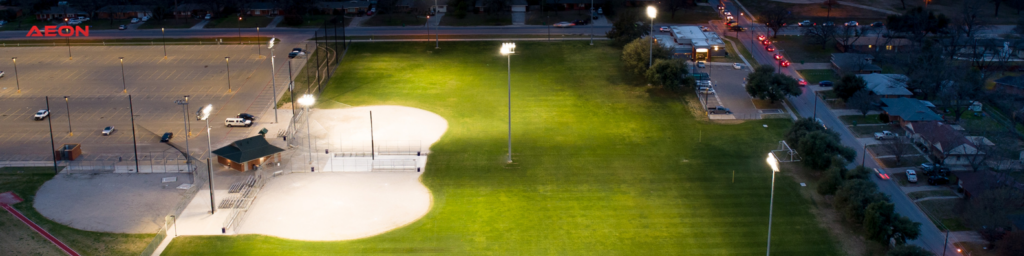
Do not wait until installation is complete to decide how performance will be checked. The Little League document includes specific field-measurement provisions and calculation-grid requirements in addition to its target values.
Ask who will verify fixture models, quantities, aiming, control operation, and field readings after installation, and what happens if the completed system differs from the approved design.
Little League’s published measurement guidance calls for horizontal readings on the specified grid with the meter held 36 inches above the field surface, and its standard discusses measurement during the first 100 hours of operation. Review the complete document for the exact procedure that applies to the project.
Useful project information includes the facility address, field dimensions, divisions using the field, existing pole locations and heights, fixture quantities, current wattages, available voltage, photographs, and any site drawings.
AEON’s layout request asks for many of these same details, including whether the project is an existing facility or new construction, the sport, voltage, pole count, mounting heights, and fixtures per pole.
AEON offers sports-lighting products and layout support. Our baseball and softball lighting guide explains the terminology used in a proposal.
Use the governing organization’s complete requirements when preparing the project, then provide the available field information so the proposed equipment can be evaluated within a site-specific layout.
Get help choosing the right AEON LED solution for your field, facility, venue, or outdoor space.