
Ready to Upgrade Your Lighting?
Get help choosing the right AEON LED solution for your field, facility, venue, or outdoor space.


Baseball and softball lighting requirements depend on the facility’s intended use and the criteria that apply to the project. Before selecting equipment, identify the governing organization, competition level, broadcast needs, and the documents the project team will use to evaluate the completed installation.
A useful lighting brief identifies more than a target brightness. Ask for the applicable light-level criteria, uniformity measures, measurement locations, glare considerations, and verification process.
This guide explains the terminology and provides selected published reference values. It is not a complete project specification or a substitute for review of the governing documents.
Foot-candles measure illuminance: the amount of light arriving at a surface. They are not the same as a luminaire’s total light output.
A fixture’s lumen rating describes light output, while a field’s foot-candle results describe the illumination calculated or measured at specified locations. When reviewing a proposal, ask where the readings apply and whether the reported values describe initial performance or a maintained target.
Do not judge a complete field-lighting design from a fixture’s wattage or lumen rating alone.
The following examples come from the named organizations’ published documents. Do not treat them as interchangeable requirements for every youth, school, college, or professional facility.
| Published reference | Infield | Outfield | How to interpret the figures |
|---|---|---|---|
| Little League standard competition | 50 fc | 30 fc | Average constant or target horizontal light levels in its lighting standards document. |
| NCAA baseball: standard intercollegiate play | 70 fc | 50 fc | Recommended horizontal light levels in the named NCAA best-practices document. |
| NCAA softball: standard intercollegiate play | 70 fc | 50 fc | Recommended horizontal light levels in the separate softball document. |
These are selected reference values, not a complete compliance checklist. Confirm the applicable document and project requirements before using a number in a design, purchase order, or construction specification. Broadcast and championship applications require review of their separate criteria.
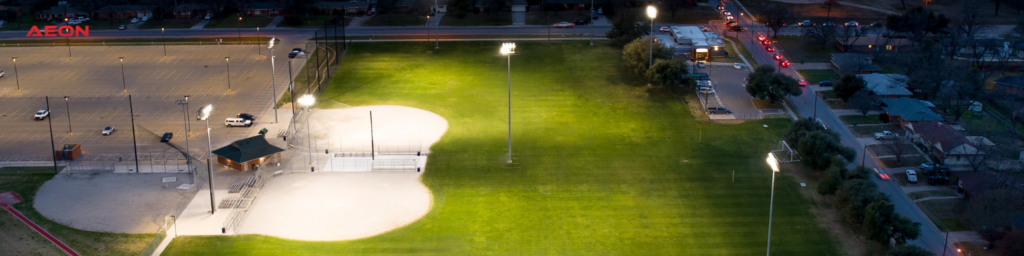
Uniformity describes how evenly light is distributed across the evaluated area. Always identify the ratio being used before comparing two reports.
A maximum-to-minimum ratio divides the highest reading by the lowest reading. An average-to-minimum ratio uses the average reading instead. Those calculations are different, so a ratio without its definition is incomplete.
For illustration, readings with a maximum of 80 fc and a minimum of 40 fc produce a maximum-to-minimum ratio of 2:1.
Little League’s published standard-competition table specifies maximum-to-minimum ratios of 2:1 for the infield and 2.5:1 for the outfield. Evaluate the relevant areas separately and consult the complete document for its other performance and measurement provisions.
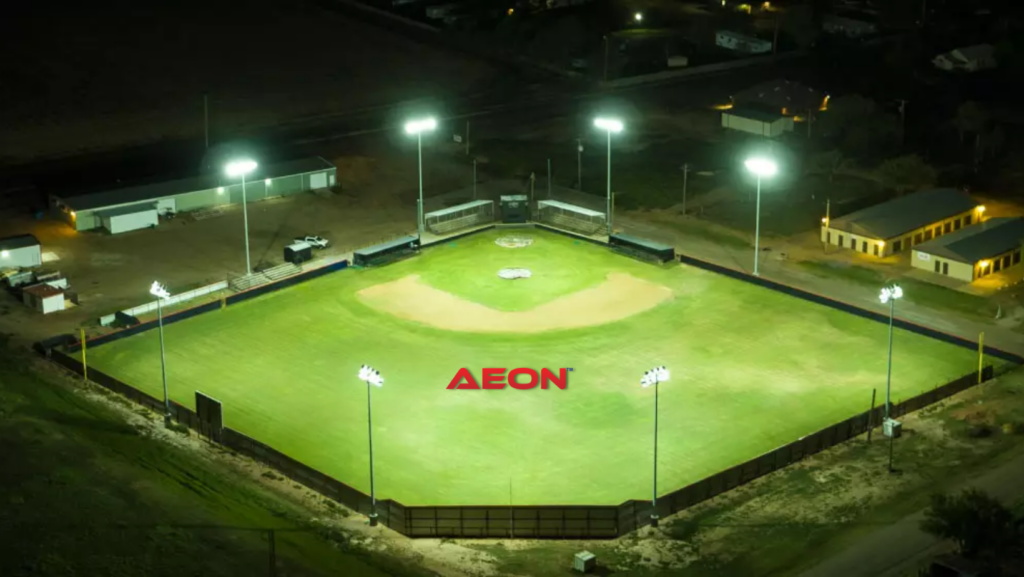
Do not choose a lighting layout solely by deciding that a particular competition level requires four, six, or eight poles. Begin with the actual field geometry and the placement guidance in the applicable reference documents.
Consider pole locations, mounting heights, optical distributions, and aiming directions together. Existing structures, available space, and the areas that need illumination also belong in the design discussion.
The NCAA’s standard-play baseball guidance illustrates both six- and eight-pole arrangements and recommends professional consultation for new facilities and upgrades. These illustrations are planning references, not a universal installation drawing for every field.
For a retrofit, have the project team evaluate the existing infrastructure rather than assuming that brighter fixtures alone will produce the required result.
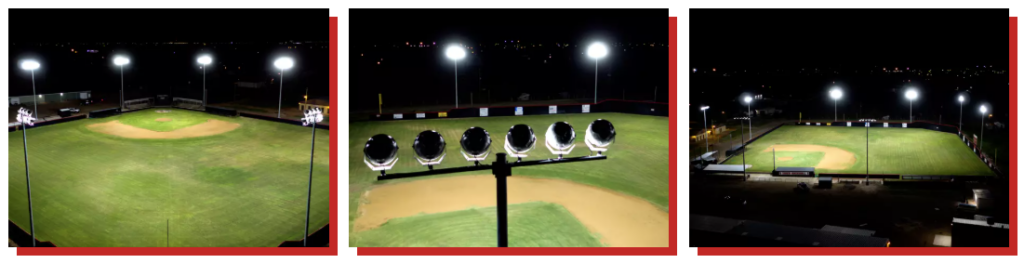
Use the actual softball field dimensions and the appropriate softball reference when preparing a layout. Do not simply shrink a baseball drawing and assume the calculation remains suitable.
Even where published horizontal light-level recommendations match, the supporting layout and evaluation details can differ. For example, the NCAA’s standard-play documents specify different calculation-grid spacing for baseball and softball.
Use the following questions when discussing a proposed design with your lighting team. They are a review aid, not a replacement for the project specification.
| Review item | Question to ask |
|---|---|
| Design criteria | Which organization, document, edition, and intended use does the proposal reference? |
| Field geometry | Does the calculation use our actual field dimensions and mounting arrangement? |
| Lighting results | Where are the calculation points, and what do the reported averages and minimums represent? |
| Uniformity | Which ratio is being reported, and are the infield and outfield evaluated separately? |
| Long-term performance | What assumptions are used for light loss or maintaining the target output? |
| Equipment | Which models, optics, mounting heights, and aiming directions are included? |
| Project boundaries | How will neighboring properties and other sensitive areas be evaluated? |
| Verification | What will be checked after installation, and who is responsible for that review? |
Once you identify your facility’s requirements, the next step is to evaluate equipment within a project-specific layout. Explore AEON baseball field lighting options, review a completed installation, and learn what information to gather before discussing your project.
Use the governing organization’s complete documents when preparing a project specification. Published guidance may differ by sport, intended use, broadcast category, and document edition. Confirm the applicable requirements with the project team before finalizing the design.
Get help choosing the right AEON LED solution for your field, facility, venue, or outdoor space.