
 English
 Spanish
 French
 Arabic
 Ukrainian
 Portuguese
 German
 Italian
 Russian
 Dutch
Dutch
Unmatched Efficiency,
Unrivaled Illumination.
Learn More About Our Eco-Friendly LED Lighting Products.
Choose an Option Below!


The word “retrofit” varies; some see it as just swapping fixtures, while others expect rewiring or pole replacement. A HID-to-LED stadium conversion benefits everyone: owners save on energy and get better lighting, contractors have cleaner installs with fewer trips, and athletes enjoy instant-on lights without warm-up delays.
Unexpected voltages, corroded splices, and breakers tripping after energizing LED drivers. Contactors suited for HID struggle with new switching, and control cabinets are not designed for dimming or scene changes.
If you’re bidding or installing a HID-to-LED stadium conversion, electrical verification is mandatory. It’s urgent. Getting it right before fixtures go up is the difference between a smooth project and expensive callbacks.
A true HID-to-LED stadium conversion often successfully reuses infrastructure, but only after it is verified. Assuming everything is reusable without inspection is where projects go sideways.
This contractor-focused guide walks through the key electrical requirements for sports lighting you should review before and during an LED stadium wiring upgrade. AEON LED Lighting supports these conversions every day with PRO Series, PNR Series, ECO Series, and High-Mast luminaires designed for demanding stadium environments.
Stadium systems are often 480V, but not always. Some campuses run 277V. Others have mixed distribution across fields and practice areas.
Verify the actual voltage at the panel and again at representative poles. Confirm whether you are dealing with line-to-line or line-to-neutral connections. Validate grounding continuity and confirm the equipment grounding conductor is intact.
Multi-voltage luminaires can simplify projects where documentation is incomplete or distribution varies. AEON sports luminaires are available in multi-voltage configurations, reducing compatibility risk and eliminating the need for last-minute driver changes.
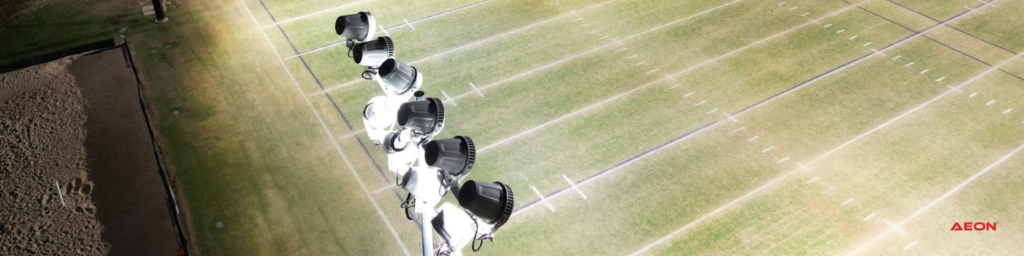
When upgrading from HID to LED stadium lighting, it’s common to believe the current wiring is already adequate, since HID systems used higher wattages. However, this assumption overlooks the potential degradation of the conductors’ physical condition. Stadium wiring can be decades old and is often exposed to moisture, temperature changes, vibration, and corrosion, particularly within pole handholes and junction boxes.
LED systems alter circuit behavior. While they use less steady current, their drivers can cause high inrush current, risking breaker trips if many fixtures turn on simultaneously, even when the load seems lower than that of HID systems. An electrical review must go beyond a simple amperage comparison.
Before energizing a new LED system, confirm the following:
HID systems were typically on/off. LED systems introduce expectations of dimming, scheduling, and scene control. If controls are not defined at the beginning of the project, they often become late add-ons that complicate wiring and labor.
If the owner wants separate practice and game modes, that must be part of the electrical plan. If they want scheduled shutdowns or remote access, that affects how control pathways are routed.
AEON luminaires are controls-ready, with 0–10V dimming capability and compatibility with intelligent lighting systems. Pairing these luminaires with AEON’s HyLink wireless lighting controls allows scheduling, scene management, and scalable operation without extensive new trenching or low-voltage wiring across the site.
Define control expectations before locking in wiring decisions.
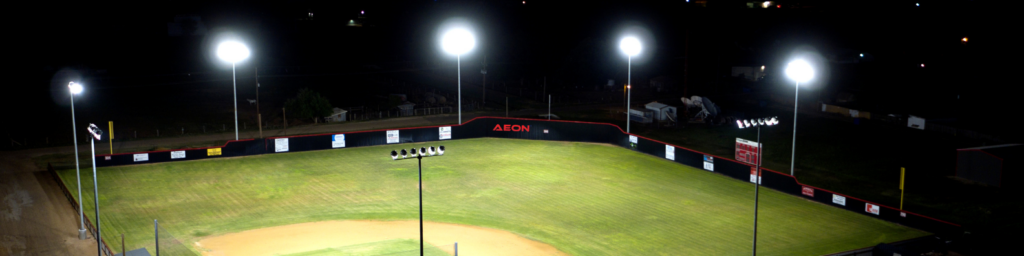
Outdoor stadium lighting lives in a harsh electrical environment. Long conductor runs and tall poles increase exposure to lightning-induced transients and utility switching surges.
During a HID-to-LED stadium conversion, confirm that grounding and bonding at each pole are intact and code-compliant. Validate that grounding electrode systems are interconnected and that equipment grounding conductors are continuous.
AEON sports luminaires include integrated surge protection ratings in their specifications. That fixture-level protection enhances durability, but it performs best when upstream grounding and surge strategies are sound.
If the stadium has a history of ballast or ignitor failures, treat surge review as a priority during the conversion. It is far less expensive to address surge protection during installation than to troubleshoot repeated driver failures later.
In a stadium retrofit, mechanical condition directly impacts electrical reliability. Even with proper wiring, issues like water intrusion, loose hardware, or conductor abrasion can lead to failures months after installation. These problems are far easier (and less expensive) to correct during the retrofit than after the season begins.
Before completing the HID-to-LED conversion, verify that:
When the installation is complete, update panel schedules. Document circuit assignments and breaker sizes. Label control zones clearly. Provide the owner with scene descriptions and shutdown logic.
Many “electrical problems” reported months later are actually operational misunderstandings. Clear documentation reduces confusion and protects both contractor and owner from unnecessary troubleshooting.
When voltage is verified, conductors are inspected, breakers are coordinated, controls are defined early, and grounding is confirmed, the project moves easily. When those steps are skipped or rushed, callbacks and frustration follow.
Our team supports contractors with purpose-built sports luminaires, integrated surge protection, multi-voltage options, and smart lighting controls designed for real-world stadium environments. We also provide free professional lighting layouts so you can validate fixture count and performance targets before committing labor and materials.
If you are pricing or planning a HID-to-LED stadium conversion, act now. Confirm the electrical conditions before you schedule lifts and crews. Use our cost calculator to estimate the financial impact of upgrading, then request a professional lighting layout to ensure the system is engineered correctly from the start.
Learn More About Our Eco-Friendly LED Lighting Products.
Choose an Option Below!